From 2026, the new documentation obligation will bring far-reaching changes for digital accessibility. Find out how to optimally prepare your company.
Act now before it's too late!
From January 2026, the Market Surveillance Authority of the Federal States (MLBF) will actively check whether companies are complying with their documentation obligations. The focus will be on providing complete proof of all measures taken to implement the requirements of the Barrier-Free Accessibility Reinforcement Act (BFSG), which comes into force on June 28, 2025.
.png?width=1600&height=800&name=pflicht%20(1).png)
Why not until January?
Market surveillance in accordance with the BFSG will not start until January 2026, as the responsible authorities in Germany had to make extensive preparations. This included setting up clear structures, developing inspection processes and training inspection staff.
The aim is to offer companies a transparent and uniform inspection procedure that sets comprehensible standards throughout Germany. As confirmed by public announcements from Saxony-Anhalt, among others, the establishment of uniform inspection mechanisms was a key prerequisite for the launch of market surveillance.
What is tested?
The audits focus on digital products and services that companies make available to the public - in particular websites, apps and online stores. The technical basis is the WCAG 2.2 standard, which defines detailed requirements for digital accessibility. The focus is not only on technical implementation, but also on the traceability and documentation of measures. Companies must be able to prove which steps they have taken towards accessibility, including an up-to-date accessibility statement.
What companies should do now
In order to fulfill the documentation obligation from 2026, companies should subject their digital offerings to an accessibility audit at an early stage. The next step is to create comprehensible documentation of all measures, including an up-to-date accessibility statement in accordance with legal requirements. This declaration must be publicly accessible and regularly updated.
It is also advisable to implement specific improvement measures immediately and document progress. In the event of an audit, companies can then transparently demonstrate which measures have been taken and how accessibility is being continuously improved.
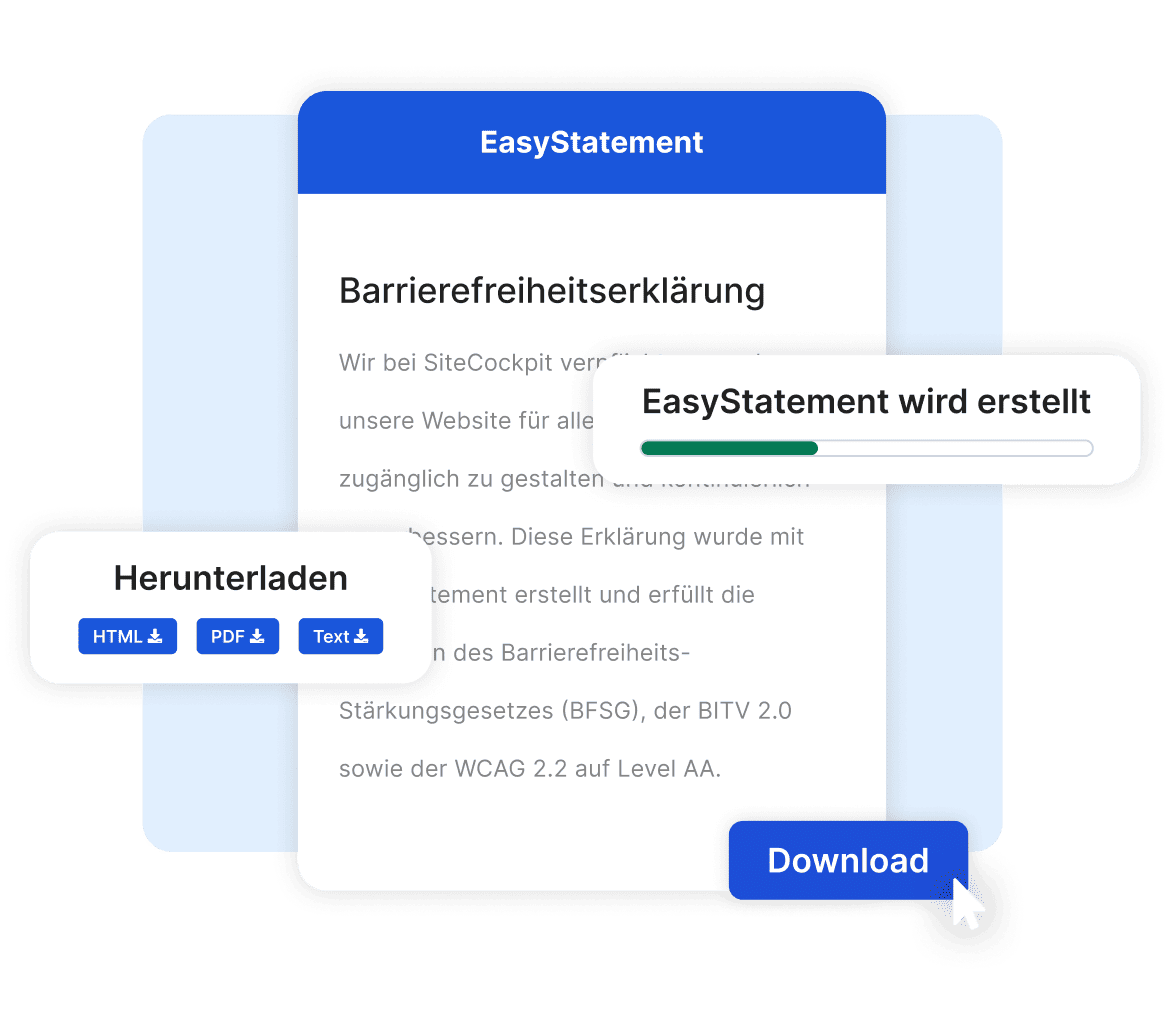
Fulfilling the documentation obligation with easyStatement
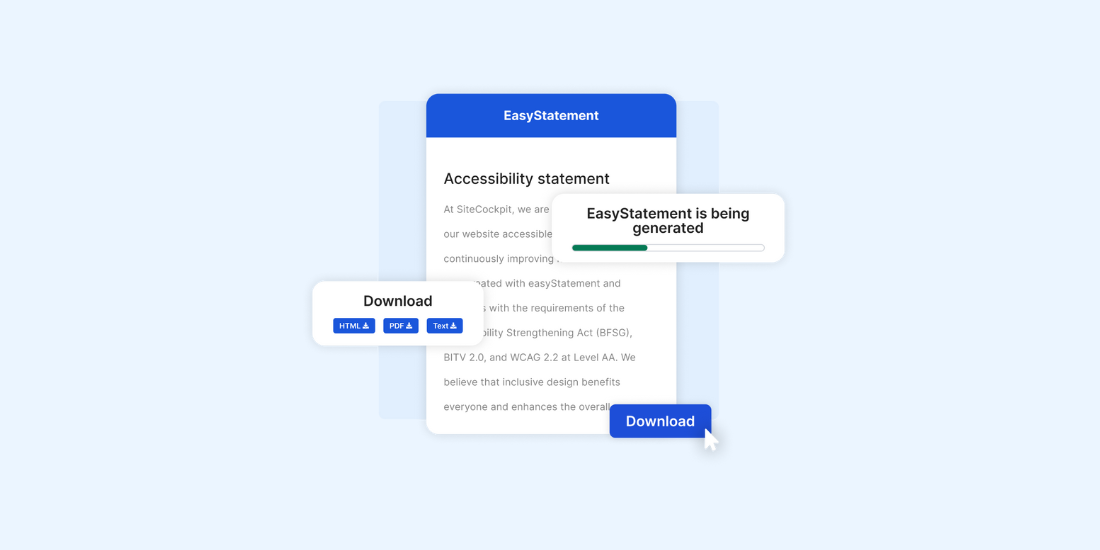
With easyStatement, companies can create and maintain their accessibility statement quickly, up-to-date and in multiple languages - based on real audits. This allows you to fulfill the central documentation requirement of the BFSG reliably and audit-proof.
The declaration can be edited at any time, is clearly structured and technically correctly integrated - exactly as expected by market surveillance.
What else SiteCockpit can do: With easyMonitoring (automated audits) and easyVision (assistance functions in the front end), you also ensure continuous monitoring and direct user support - modular, system-independent and without relaunch.

.png?width=1600&height=800&name=einfache_leichte_sprache%20(1).png)
.png?width=1600&height=800&name=performance%20(1).png)